
Taktisch-medizinisches Seminar · Zwei Module
TRAUMA RESPONSE
Praxisnahe Notfallmedizin für kritische Situationen in zwei einzeln buchbaren Tagen: Tag 1 Basics — jedes Werkzeug aus dem IFAK, vom Tourniquet bis zum Chest Seal. Tag 2 Advanced — Stich-, Schuss-, Explosions- und Brandverletzungen sowie Triage im MANV, im Szenariotraining mit Prüfung und Zertifikat. Mit neuestem Trainingsmaterial, das es derzeit sonst nirgends in Deutschland gibt.
Worum es geht
Zwei Tage, zwei Module, ein System
Trauma Response – praxisnahe Notfallkompetenz für urbane Einsatzrealität, in zwei aufeinander aufbauenden Tagen.
Schwere Blutungen, Verkehrsunfälle, Messerangriffe, Explosionen oder terroristische Ereignisse: In kritischen Situationen entscheiden oft die ersten Minuten über Leben und Tod. Unser Trauma Response Seminar vermittelt lebensrettende Sofortmaßnahmen auf Basis der aktuellen Leitlinien aus TCCC (Tactical Combat Casualty Care) und TECC (Tactical Emergency Casualty Care) – konsequent übersetzt auf die Anforderungen ziviler Teilnehmer*innen im urbanen Umfeld.
Tag 1 – Trauma Response Basics legt das Fundament: Du lernst jedes Werkzeug aus dem IFAK kennen und wendest es an – Tourniquet, hämostatische Gaze, Druckverband, Chest Seal, Rettungsdecke – und trainierst den Ablauf nach MARCH in Vorträgen, Skill Stations und ersten Szenarien. Tag 2 – Trauma Response Advanced arbeitet mit diesem Fundament an den typischen Verletzungsmustern: Stich- und Schnittverletzungen, Schussverletzungen, Explosionstraumata und Verbrennungen – jeweils im Szenariotraining unter Zeitdruck – sowie an der Triage bei MCI-/MANV-Lagen, wenn mehrere Verletzte gleichzeitig versorgt werden müssen. Den Abschluss bilden eine Prüfung und das Zertifikat.
Anders als militärische Programme konzentriert sich das Seminar auf realistische Lagen, wie sie in Städten wie Berlin auftreten können: Verkehrsunfälle, Gewaltkriminalität, Massenpanik, Terrorlagen oder komplexe Notfallsituationen im öffentlichen Raum. Militärische Evakuierungsabläufe oder taktische Funkverfahren stehen bewusst nicht im Vordergrund – stattdessen trainieren wir Maßnahmen, die für Zivilpersonen, Sicherheitskräfte, Unternehmen und verantwortungsbewusste Bürger*innen tatsächlich relevant und unmittelbar umsetzbar sind.
Tag 1 · Basics
Die Grundlagen: Eigenschutz, MARCH, das komplette IFAK in der Anwendung. Ohne Vorkenntnisse – auch einzeln buchbar.
Tag 2 · Advanced
Die Verletzungsmuster: Stich, Schuss, Explosion, Verbrennung – plus Triage im MANV. Im Szenario, mit Prüfung und Zertifikat. Voraussetzung: Tag 1.
Paket · beide Tage
Ein Wochenende, beide Module, ein Zertifikat. 299 € regulär, 199 € für Mitglieder – 19 € günstiger als beide Tage einzeln.
Für wen dieses Seminar ist
Trauma Response richtet sich an Zivilist*innen, die vorbereitet sein und ihre Resilienz stärken wollen – Menschen, die im Alltag, im Beruf oder in der Familie handlungsfähig bleiben möchten, wenn etwas passiert. Medizinische Vorkenntnisse brauchst Du nicht: Ein regulärer Erste-Hilfe-Kurs ist hilfreich, aber keine Voraussetzung. Das Seminar ist bewusst keine Fortbildung für Rettungsdienst, Polizei oder Bundeswehr – für Profis mit medizinischem Hintergrund sind unsere TCCC- und TECC-Seminare gedacht.
Trainingsmaterial, das es sonst nirgends gibt
Wir trainieren mit dem aktuell neuesten Simulations- und Übungsmaterial für die Traumaversorgung – derzeit in keinem anderen Kurs in Deutschland im Einsatz. Was Du an Tag 1 in die Hand nimmst und an Tag 2 im Szenario einsetzt, entspricht dem Stand, mit dem heute ausgebildet wird – nicht dem von vor zehn Jahren.
Kursdetails
Kursdetails
DATEN
Termin auf Anfrage ·
DAUER
2 Tage à 8 Stunden · einzeln buchbar
MODULE
Tag 1 Basics · Tag 2 Advanced
SPRACHEN
Deutsch, Englisch
VORKENNTNISSE
Tag 1: keine · Tag 2: Tag 1
ABSCHLUSS
Prüfung & Zertifikat an Tag 2
MATERIAL
Neuestes Trainingsmaterial, einzigartig in Deutschland
MINDESTALTER
18 Jahre
ZIELGRUPPE
Zivilist*innen ohne medizinischen Hintergrund
Module
Tag 1 Basics & Tag 2 Advanced
Beide Tage folgen derselben Systematik – dem MARCH-Algorithmus aus TCCC und TECC: Massive Bleeding, Airway, Respiration, Circulation, Hypothermia. Tag 1 baut die Werkzeuge und Handgriffe auf, Tag 2 setzt sie an realistischen Verletzungsmustern unter Zeitdruck ein. Grundlage sind die aktuellen Richtlinien des Committee on TCCC (Deployed Medicine) und des C-TECC / NAEMT – übersetzt auf zivile Ersthelfer*innen ohne erweiterte medizinische Befugnisse.
Tag 1 – Trauma Response Basics
Vortrag, Skill Station, Szenario – in dieser Reihenfolge, für jedes Werkzeug im IFAK. Am Ende des Tages versorgst Du eine verletzte Person vollständig nach MARCH.
Modul 1
Grundlagen & Eigenschutz
Lage beurteilen, Eigenschutz, die Phasen der Versorgung aus TCCC/TECC in ziviler Übersetzung – von der unmittelbaren Bedrohung bis zur Übergabe. Notruf und Zusammenarbeit mit dem Rettungsdienst.
Modul 2
Dein IFAK
Aufbau, Inhalt, Trage- und Zugriffskonzept des Individual First Aid Kit für zu Hause und unterwegs. Jedes Werkzeug wird nicht nur erklärt, sondern angewendet.
Modul 3
Massive Bleeding
Tourniquet an Arm und Bein – an Dir selbst und an anderen, mit einer Hand, unter Zeitdruck. Wound Packing mit hämostatischer Gaze, Druckverband, Blutungskontrolle an Übergangszonen.
Modul 4
Airway & Respiration
Atemweg freimachen und offen halten durch Lagerung und stabile Seitenlage. Atmung beurteilen, Chest Seal bei penetrierenden Thoraxverletzungen.
Modul 5
Circulation & Hypothermia
Schock erkennen, Prioritäten setzen, Wärmeerhalt mit Rettungsdecke und Improvisation. Reassessment: Was hat gewirkt, was muss nachgezogen werden?
Modul 6
Skill Stations & Szenarien
Stationstraining zu jedem Werkzeug, danach erste Szenarien mit Moulage und Stressfaktoren. Abschluss des Tages: eine vollständige Versorgung nach MARCH.
Tag 2 – Trauma Response Advanced
Voraussetzung: Tag 1 – auch aus einem früheren Termin. An Tag 2 geht es um typische Verletzungsmuster aus Gewalt- und Terrorlagen, um Triage bei MCI-/MANV-Lagen, jeweils mit Szenariotraining, und um den Abschluss mit Prüfung und Zertifikat.
Modul 7
Refresher, Assessment & Triage
MARCH unter Zeitdruck, systematische Untersuchung (Blood Sweep) – und Triage bei MCI-/MANV-Lagen: Sichtungskategorien, Prioritäten und Ressourcen, wenn mehrere Verletzte gleichzeitig Hilfe brauchen. Wer zuerst, was zuerst?
Modul 8
Stich- & Schnittverletzungen
Verletzungsmuster nach Messerangriffen, kritische Zonen an Hals, Achsel und Leiste, Fremdkörper belassen und fixieren, Wundpackung an schwierigen Stellen.
Modul 9
Schussverletzungen
Ein- und Ausschuss finden, Verletzungen an Thorax, Bauch, Becken und Extremitäten, Kombination aus Tourniquet, Packing und Chest Seal am selben Patienten.
Modul 10
Explosionstraumata
Primär- bis Quartärverletzungen, Amputationen, mehrere Verletzte gleichzeitig, Sekundärgefahren und Selbstschutz am Ereignisort.
Modul 11
Verbrennungen
Kühlen, abdecken, Ausmaß abschätzen, Inhalationstrauma erkennen – und Wärmeerhalt trotz Verbrennung. Was sinnvoll ist und was schadet.
Modul 12
Szenarien, Prüfung & Zertifikat
Patient Movement mit Drags und Carries, Übergabe an den Rettungsdienst nach MIST, Abschlussszenario mit mehreren Verletzten. Danach theoretische und praktische Prüfung und das Zertifikat.
Vorkenntnisse
Für Tag 1 brauchst Du keine Vorkenntnisse. Ein regulärer Erste-Hilfe-Kurs ist hilfreich, aber keine Voraussetzung. Tag 2 setzt die Teilnahme an Tag 1 voraus – wer die Basics bereits bei einem früheren Termin absolviert hat, kann direkt in den Advanced-Tag einsteigen.
Methodik
Beide Tage werden mit Präsentationen, Skill Stations, Teamarbeit, Rollenspielen und Szenarien mit Moulage unterrichtet. Tag 2 endet mit einem komplexen Abschlussszenario sowie einer theoretischen und praktischen Prüfung. Schwerpunkt: Die richtige Maßnahme zur richtigen Zeit – unter Stress.
Ausrüstung
Was braucht Ihr?
- Hose mit Gürtelschlaufen
- Fester Gürtel
- Bequeme Schuhe
- Wetterangepasste Kleidung
- Tag 2: Dein eigenes IFAK, falls vorhanden
All Inclusive
Alles drin
Beide Tage beinhalten die Gebühren für die Trainingslocation, Instruktor*innen, Schutzkleidung, Waffen und medizinisches Trainingsmaterial sowie Snacks und Drinks – inklusive des neuesten Trainingsmaterials, das derzeit sonst nirgends in Deutschland im Einsatz ist. An Tag 1 bekommt jede*r Teilnehmer*in ein Trainingstourniquet, an Tag 2 sind Prüfung und Zertifikat inklusive.
Einblick
So sieht das aus
Termine & Buchung
Der nächste Kurs
Termin
Termin auf Anfrage
Tag 1 Basics · Tag 2 Advanced
Beginn 10:00 Uhr
Weitere Termine
Tarife
Paket
299 €
Beide Tage
Mitglied 199 €
Tag 1
159 €
Basics
Mitglied 109 €
Tag 2
159 €
Advanced
Mitglied 109 €
Beide Tage zusammen sparen 19 €. Tag 2 setzt Tag 1 voraus. Du bist Mitglied? Melde Dich vor der Buchung kurz bei uns.
Probleme bei der Buchung? Schreib uns per WhatsApp · powered by Glofox
Weiter im Thema
Mehr medizinische Themen bei uns
Ein Beitrag zum Nachrüsten, ein Podcast zum Hören, ein Kurs für Sportschützen und der Überblick über alles, was wir zum Thema anbieten.
 Blog
BlogDein IFAK
Was in ein individuelles Erste-Hilfe-Set gehört und was nicht — und warum das billigste Tourniquet das teuerste sein kann.
Beitrag lesen › Podcast
Taktische Medizin
Der Podcast des Leitenden Rettungsmediziners der Bundeswehr. Fachlich dicht, ohne Effekthascherei.
Bei Apple Podcasts hören › Kurs
KursTrauma Response for Sport Shooters
Dieselbe Systematik, zugeschnitten auf den Schießstand: Schussverletzungen und was vor dem Rettungsdienst passiert.
Zum Kurs ›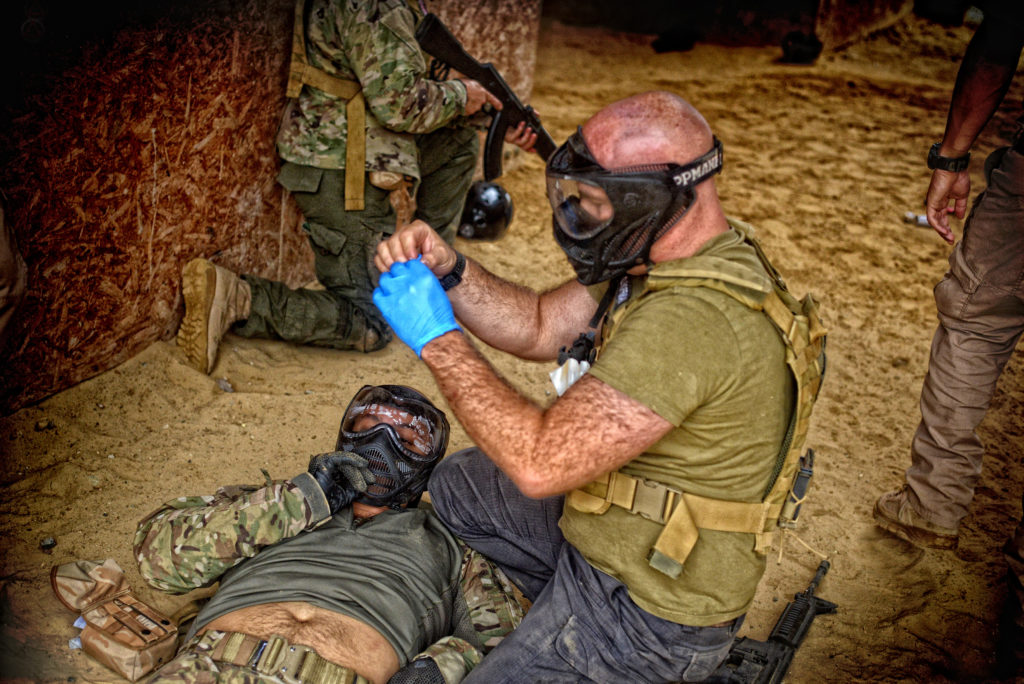 Übersicht
Taktische Medizin
Der Sammelplatz: welche Kurse und Seminare Medizin enthalten, wer sie unterrichtet und wo Du weiterliest.
Zur Übersicht ›Tactical medical seminar · Two modules
TRAUMA RESPONSE
Hands-on emergency medicine for critical situations, in two separately bookable days: Day 1 Basics — every tool in the IFAK, from tourniquet to chest seal. Day 2 Advanced — stab, gunshot, blast and burn injuries plus triage in mass-casualty incidents, in scenario training with exam and certificate. With the newest training material, currently available nowhere else in Germany.
What it is about
Two days, two modules, one system
Trauma Response – hands-on emergency skills for the reality of urban incidents, in two days that build on each other.
Severe bleeding, traffic accidents, knife attacks, explosions or terrorist events: In critical situations the first minutes often decide between life and death. Our Trauma Response seminar teaches life-saving immediate measures based on the current guidelines of TCCC (Tactical Combat Casualty Care) and TECC (Tactical Emergency Casualty Care) – consistently translated to the needs of civilian participants in an urban environment.
Day 1 – Trauma Response Basics lays the foundation: You get to know every tool in the IFAK and use it – tourniquet, haemostatic gauze, pressure bandage, chest seal, emergency blanket – and train the MARCH sequence in lectures, skill stations and first scenarios. Day 2 – Trauma Response Advanced builds on that foundation and works through the typical injury patterns: stab and cut wounds, gunshot wounds, blast trauma and burns – each in scenario training under time pressure – as well as triage in mass-casualty incidents (MCI), when several casualties need care at the same time. The day ends with an exam and the certificate.
Unlike military programmes, the seminar focuses on realistic situations as they can occur in cities like Berlin: traffic accidents, violent crime, mass panic, terror incidents or complex emergencies in public spaces. Military evacuation procedures or tactical radio protocols are deliberately not the focus – instead we train measures that are actually relevant and immediately applicable for civilians, security staff, companies and responsible citizens.
Day 1 · Basics
The foundations: self-protection, MARCH, the complete IFAK in use. No prior knowledge needed – bookable on its own.
Day 2 · Advanced
The injury patterns: stab, gunshot, blast, burn – plus triage in mass-casualty incidents. In scenarios, with exam and certificate. Prerequisite: Day 1.
Package · both days
One weekend, both modules, one certificate. €299 regular, €199 for members – €19 less than both days booked separately.
Who this seminar is for
Trauma Response is aimed at civilians who want to be prepared and strengthen their resilience – people who want to stay capable of acting in everyday life, at work or with their family when something happens. You do not need any medical background: A regular first-aid course is helpful but not required. The seminar is deliberately not a continuing-education course for EMS, police or armed forces – professionals with a medical background are better served by our TCCC and TECC seminars.
Training material you will find nowhere else
We train with the very latest simulation and practice material for trauma care – currently not in use in any other course in Germany. What you pick up on Day 1 and use in the scenarios on Day 2 reflects the standard being taught today – not the one from ten years ago.
Course details
Course details
DATES
Termin auf Anfrage ·
DURATION
2 days of 8 hours · bookable separately
MODULES
Day 1 Basics · Day 2 Advanced
LANGUAGES
German, English
PREREQUISITES
Day 1: none · Day 2: Day 1
CERTIFICATION
Exam & certificate on Day 2
MATERIAL
Newest training material, unique in Germany
MINIMUM AGE
18 years
TARGET GROUP
Civilians without a medical background
Modules
Day 1 Basics & Day 2 Advanced
Both days follow the same system – the MARCH algorithm from TCCC and TECC: Massive Bleeding, Airway, Respiration, Circulation, Hypothermia. Day 1 builds the tools and hand skills, Day 2 applies them to realistic injury patterns under time pressure. The basis are the current guidelines of the Committee on TCCC (Deployed Medicine) and of C-TECC / NAEMT – translated for civilian first responders without extended medical privileges.
Day 1 – Trauma Response Basics
Lecture, skill station, scenario – in that order, for every tool in the IFAK. By the end of the day you treat an injured person completely according to MARCH.
Module 1
Foundations & self-protection
Assessing the situation, self-protection, the phases of care from TCCC/TECC in civilian translation – from the immediate threat to handover. Emergency call and working with EMS.
Module 2
Your IFAK
Structure, contents, carry and access concept of the Individual First Aid Kit for home and on the go. Every tool is not just explained but used.
Module 3
Massive Bleeding
Tourniquet on arm and leg – on yourself and on others, one-handed, under time pressure. Wound packing with haemostatic gauze, pressure bandage, bleeding control in junctional zones.
Module 4
Airway & Respiration
Clearing and maintaining the airway through positioning and the recovery position. Assessing breathing, chest seal for penetrating chest injuries.
Module 5
Circulation & Hypothermia
Recognising shock, setting priorities, preventing heat loss with emergency blanket and improvisation. Reassessment: What worked, what needs adjusting?
Module 6
Skill stations & scenarios
Station training for every tool, then first scenarios with moulage and stress factors. End of the day: a complete treatment according to MARCH.
Day 2 – Trauma Response Advanced
Prerequisite: Day 1 – also from an earlier date. Day 2 is about typical injury patterns from violent and terror incidents, about triage in mass-casualty incidents, each with scenario training, and about finishing with exam and certificate.
Module 7
Refresher, assessment & triage
MARCH under time pressure, systematic examination (blood sweep) – and triage in mass-casualty incidents: triage categories, priorities and resources when several casualties need help at once. Who first, what first?
Module 8
Stab & cut wounds
Injury patterns after knife attacks, critical zones at neck, armpit and groin, leaving and securing impaled objects, wound packing in difficult locations.
Module 9
Gunshot wounds
Finding entry and exit wounds, injuries to chest, abdomen, pelvis and extremities, combining tourniquet, packing and chest seal on the same patient.
Module 10
Blast trauma
Primary to quaternary injuries, amputations, several casualties at once, secondary hazards and self-protection at the scene.
Module 11
Burns
Cooling, covering, estimating the extent, recognising inhalation injury – and preventing heat loss despite the burn. What helps and what harms.
Module 12
Scenarios, exam & certificate
Patient movement with drags and carries, handover to EMS using MIST, final scenario with several casualties. Then the theoretical and practical exam and the certificate.
Prerequisites
You need no prior knowledge for Day 1. A regular first-aid course is helpful but not required. Day 2 requires participation in Day 1 – if you completed the Basics on an earlier date, you can join the Advanced day directly.
Methodology
Both days are taught with presentations, skill stations, teamwork, role play and scenarios with moulage. Day 2 ends with a complex final scenario as well as a theoretical and practical exam. Focus: The right measure at the right time – under stress.
Equipment
What do you need?
- Trousers with belt loops
- Sturdy belt
- Comfortable shoes
- Weather-appropriate clothing
- Day 2: your own IFAK, if you have one
All Inclusive
Everything included
Both days include the fees for the training location, instructors, protective equipment, weapons and medical training material as well as snacks and drinks – including the newest training material, currently not in use anywhere else in Germany. On Day 1 every participant receives a training tourniquet, on Day 2 the exam and certificate are included.
Insight
What it looks like
Dates & Booking
The next course
Date
Termin auf Anfrage
Day 1 Basics · Day 2 Advanced
Starts at 10:00
More dates
Prices
Package
299 €
Both days
Member 199 €
Day 1
159 €
Basics
Member 109 €
Day 2
159 €
Advanced
Member 109 €
Booking both days saves €19. Day 2 requires Day 1. Are you a Member? Get in touch briefly before booking.
Trouble booking? Message us on WhatsApp · powered by Glofox
More on the topic
More medical topics with us
An article on gearing up, a podcast to listen to, a course for sport shooters and the overview of everything we offer on the subject.
BlogYour IFAK
What belongs in an individual first aid kit and what does not — and why the cheapest tourniquet can be the most expensive one.
Read the article ›PodcastTactical Medicine
The podcast of the Bundeswehr's chief emergency physician. Dense in substance, no sensationalism.
Listen on Apple Podcasts ›CourseTrauma Response for Sport Shooters
The same system, tailored to the shooting range: gunshot wounds and what happens before EMS arrives.
To the course ›OverviewTactical Medicine
The hub: which courses and seminars include medicine, who teaches them and where to read on.
To the overview ›