
Programm · Nur für geschlossene Gruppen
FIRST RESPONSE TEAMS
Aufbau, Ausbildung und Nachhalten von Ersteingreifer-Teams — für Gemeinden, Einrichtungen und Unternehmen, die im Ernstfall die ersten Minuten selbst tragen müssen.
Worum es geht
Die ersten Minuten gehören Euch
Ob Gemeinde, Schule, Klinik oder Unternehmen — wenn etwas passiert, vergeht Zeit, bis Polizei und Rettungsdienst da sind. Diese Zeit trägt, wer vor Ort ist. Ein First Response Team ist die Antwort darauf: eine feste, benannte, geübte Gruppe aus den eigenen Reihen, die weiß, was sie in diesen Minuten tut — und was ausdrücklich nicht.
Wir bauen solche Teams auf, bilden sie aus und halten sie über die Jahre auf Stand. Die Grundlage ist israelische Methodik aus der Gemeindesicherheit, übersetzt in den Rechtsrahmen des jeweiligen Landes — getragen von fast drei Jahrzehnten Erfahrung aus Berlin.
Das Programm ist kein Kurs von der Stange. Es beginnt mit einer Bestandsaufnahme und endet nicht mit dem letzten Ausbildungstag, sondern mit einem Plan, wie das Team geübt bleibt.
Die Teams kommen aus der Organisation selbst — Freiwillige, in der Regel vier bis sechzehn Personen, und zwar bewusst aus allen Bereichen. In einer jüdischen Schule sitzen in so einem Team schon mal die Hausmeisterin, zwei Lehrkräfte, die Co-Direktorin, ein Koch und der Systemadministrator. Diese Streuung ist Absicht: Sie bringt unterschiedliche Wege durchs Haus, unterschiedliche Schlüssel, unterschiedliche Blickwinkel und unterschiedliche Fähigkeiten an einen Tisch.
Einschlägige Vorkenntnisse sind willkommen — medizinische Ausbildung, OSINT-Erfahrung, Kampfsport, Technik. Entscheidend sind sie nicht. Die beiden Eigenschaften, auf die es wirklich ankommt, sind Kopf und Verbindlichkeit: Wer mitdenkt und dabeibleibt, ist für ein Team wertvoller als jede Vorqualifikation. Alles andere bringen wir bei.
Der Umfang
80 Stunden Grundausbildung
Die Grundausbildung umfasst 80 Stunden netto in zehn Modulen zwischen vier und 24 Unterrichtseinheiten. Zwei dieser Module laufen als Blockseminare mit je zwei Übernachtungen — Vollpension, Transport und sämtliches Ausbildungs-, Schutz- und Übungsmaterial sind enthalten.
Ausgebildet wird in Gruppen bis zwölf Personen, in Tages- und Blockseminaren nach den Möglichkeiten Eurer Niederlassung und Eurer Leute. Den Abschluss bildet ein umfangreiches Szenarientraining unter realistischen Bedingungen.
Danach hört es nicht auf. Je nach Gefährdungslage der Organisation bilden wir das Team wöchentlich bis quartalsweise fort — ohne diese Wiederholung zerfällt jedes Team innerhalb von Monaten. Die Mitglieder arbeiten ehrenamtlich; die Ausbildung stellt die Organisation.
Die Ausbildung
Vier Bereiche, zehn Module
Die zehn Module verteilen sich auf vier Bereiche. Sie bauen aufeinander auf: erkennen, handeln, versorgen, übergeben. Wie tief jeder Bereich ausfällt, hängt vom Auftrag und von der Gefährdungslage ab.
01 · Prävention
Predictive Profiling, Counter Surveillance, Violence Dynamics, technische Sicherungen, Qualitätssicherung der eigenen Abläufe, PTBS-Prävention und die Beratung des eigenen Teams. Der Teil, der die meisten Vorfälle verhindert, bevor sie einer werden.
02 · Unmittelbare Gefahrenabwehr
Waffenloser Nahkampf auf Basis von Krav Maga und der Umgang mit Waffen: Schusswaffen, Messer, Schlagwaffen, chemische Wirkmittel und improvisierte Mittel. Geschossen wird mit scharfen Waffen auf zugelassenen Ständen, unter Aufsicht von Range Safety Officer und Schießausbilder — im Rahmen dessen, was Auftrag und Rechtslage des jeweiligen Landes zulassen.
03 · Taktische Medizin
TCCC- und TECC-Prinzipien, Trauma Response Training und der Einsatz taktisch-medizinischer Ausrüstung. Starke Blutungen, Atemweg, Wärme — der Bereich, der am häufigsten wirklich gebraucht wird.
04 · After Incident Procedures
Einweisung und Einsatzübergabe an Polizei, Feuerwehr, Rettungsdienst und THW, Arbeit am Tatort, Zeugengewinnung und Beweissicherung, Überwachung der Einsatzqualität. Was nach den ersten Minuten passiert, entscheidet über Aufklärung und Verfahren.
Die Bausteine
Acht Bausteine, ein belastbares Team
Welche Bausteine in Eurem Programm stecken und wie tief, hängt vom Auftrag ab. Sie verteilen sich auf die vier Ausbildungsbereiche und reichen von der Aufstellung des Teams bis zur jährlichen Übung.
01 · Auftrag und Rechtsrahmen
Was das Team darf, was es soll und wo die Grenze verläuft — schriftlich festgehalten, bevor irgendjemand trainiert. Jedes Land, jeder Träger hat einen anderen Rahmen.
02 · Auswahl und Aufstellung
Wer gehört ins Team, wer nicht. Belastbarkeit, Verfügbarkeit, Rolle im Alltag. Lieber sechs zuverlässige Leute als zwanzig auf einer Liste.
03 · Lagebild und Alarmierung
Wer merkt was zuerst, wie kommt die Meldung an, wer entscheidet. Meldewege, die auch nachts und im Urlaub funktionieren.
04 · Angriffsvorbereitung erkennen
Ausbaldowern, Testläufe, ungewöhnliches Interesse: die Indikatoren vor der Tat. Beobachten, dokumentieren, weitergeben — ohne Paranoia im Alltag.
05 · Zugang und Perimeter
Eingänge, Veranstaltungen, Besucherströme. Wie man Menschen freundlich und trotzdem wirksam durch eine Kontrolle führt.
06 · Körperliche Intervention
Handlungsfähigkeit auf dem Niveau, das der Rechtsrahmen zulässt: Abstand halten, lösen, festhalten, Zeit gewinnen — nicht kämpfen, um zu gewinnen. Wo Auftrag und Rechtslage es zulassen, kommt der Umgang mit Waffen dazu, bis hin zum scharfen Schuss auf zugelassenen Ständen.
07 · Erstversorgung unter Bedingungen
Taktische Medizin nach TCCC und TECC: starke Blutungen, Atemweg, Wärme. Der Teil, der am häufigsten wirklich gebraucht wird.
08 · Üben und Nachhalten
Ein Jahresplan aus kurzen Wiederholungen, ein Szenarientag pro Jahr, klare Auswertung. Ohne das zerfällt jedes Team innerhalb von Monaten.
Für wen
Drei Ausgangslagen, dieselbe Aufgabe
Das Programm richtet sich an Gruppen, die im Ernstfall zuerst da sind — nicht an Einzelpersonen. Teilnahme nur als geschlossene Gruppe.
Jüdische und israelische Einrichtungen
Gemeindezentren, Schulen, Synagogen, Veranstaltungen sowie israelische Kultur- und Bildungseinrichtungen, Betriebe und Projekte. Der Bereich, aus dem die Methodik stammt und in dem wir seit den 1990er Jahren arbeiten.
Kitot Konenut und Bereitschaftsgruppen
Bestehende Einheiten, die strukturiert ausgebildet, nachgeschärft und in ein festes Übungsjahr gebracht werden sollen.
Menschenrechts-NGOs und angefeindete Objekte
Organisationen, die zu Antisemitismus, Rassismus, Frauenrechten oder Extremismus arbeiten — und Häuser, die von Nazis, Islamisten, Rassisten, Antisemiten oder Frauenfeinden ins Visier genommen werden.
Wir bilden First Response Teams ausschließlich für Menschenrechts-NGOs, für jüdische und israelische Einrichtungen sowie für Objekte aus, die von Nazis, Islamisten, Rassisten, Antisemiten oder Frauenfeinden angefeindet werden. Für andere Organisationen arbeiten wir nicht — das ist keine Frage der Kapazität, sondern eine Entscheidung.
Der Nutzen
Was beide Seiten davon haben
Ein First Response Team muss sich zweimal rechnen: für die Einrichtung, die es aufstellt, und für die Menschen, die es ehrenamtlich tragen. Beides steht hier nebeneinander.
Für die Organisation
9 GründeWas eine Einrichtung gewinnt, die auf eigene Leute setzt statt auf gebuchte Dienste.
Kosten, die im Verhältnis stehen
Ein FRT aufzustellen kostet einen Bruchteil dessen, was dauerhaft gebuchte Sicherheitsdienste kosten. Für viele Einrichtungen ist es überhaupt der einzige Weg, nicht nur an einzelnen Tagen geschützt zu sein.
Fast immer jemand vor Ort
Das Team besteht aus Menschen, die ohnehin da sind — auch bei der kleinen Sitzung, beim Ausflug, bei der Abendveranstaltung. Also genau dort, wo niemand einen Wachdienst bestellen würde.
Commitment statt Dienstplan
Eigene Leute passen auf eigene Leute auf. Wer für 12,70 € in der Stunde an der Tür steht, bringt sich im Zweifel zuerst selbst in Sicherheit — auch professionelle Kräfte tun das. Diese Rechnung stellt im eigenen Team niemand auf.
Wissen, das im Haus bleibt
Die Expertise gehört der Organisation, nicht einem Dienstleister. Sie wandert nicht mit dem nächsten Vertragswechsel ab und steht bei jeder Veranstaltungsplanung, jedem Umbau und jeder Reise intern zur Verfügung.
Der Blick von innen
Das Team kennt Haus, Wege, Schlüssel und Abläufe — und die Menschen. Wer nicht hierher gehört und was nicht normal ist, fällt Leuten aus den eigenen Reihen Wochen früher auf als einem wechselnden Posten am Eingang.
Schutz ohne Festungsoptik
Keine Uniformen, keine Abriegelung. Der Charakter der Gemeinde, der Schule, des Hauses bleibt erhalten — die Handlungsfähigkeit ist trotzdem da, unsichtbar für alle anderen.
Anschlussfähig an die Einsatzkräfte
Benannte Ansprechpartner, geübte Übergabe, vorbereitete Lageinformation. Polizei, Feuerwehr und Rettungsdienst arbeiten schneller, wenn sie beim Eintreffen jemanden vorfinden, der strukturiert berichten kann.
Belastbar auch nach außen
Rollen, Meldewege und Übungen sind dokumentiert und damit gegenüber Trägern, Zuwendungsgebern und Versicherern belegbar. Und im Haus sinkt die Angst: Veranstaltungen finden statt, statt abgesagt zu werden.
Erkennen statt reagieren
Vorbereitungshandlungen — Ausbaldowern, Testläufe, ungewöhnliches Interesse — zeigen sich über Wochen. Wer ohnehin täglich im Haus ist, erkennt dieses Muster. Eine wechselnde Wachmannschaft sieht immer nur den heutigen Tag.
Für die Mitglieder
9 GründeWas die Menschen mitnehmen, die diese Aufgabe neben ihrer eigentlichen Arbeit übernehmen.
Eine Ausbildung, die es sonst nicht gibt
80 Stunden bei Ausbildern aus Militär, Polizei, Rettungsdienst und Kampfsport. In dieser Zusammenstellung — Prävention, Nahkampf, Schießen, taktische Medizin, Forensik, Risk & Threat Assessment — ist sie zivil praktisch nicht zu bekommen.
Führung unter Druck
Entscheiden mit unvollständigen Informationen, klar sprechen, wenn andere verstummen, Aufgaben verteilen, ohne zu diskutieren, hinterher ehrlich auswerten. Leadership lernt man nirgends so schnell wie in Lagen ohne zweite Runde — und im Berufsalltag ist genau das die knappste Fähigkeit.
Wissen fürs ganze Leben
Eine starke Blutung stoppen, einen Angriff abwehren, eine Lage einschätzen, einen Raum lesen. Das hilft im Straßenverkehr, auf Reisen, in der eigenen Familie — und in jedem anderen Job.
Stipendium für eine Krav-Maga-Schule
Mitglieder trainieren so oft sie wollen. Fitness, Stressfestigkeit und Resilienz sind Teil der Ausbildung, nicht Nebensache.
Handlungsfähig statt ausgeliefert
Der Unterschied zwischen „ich hoffe, es passiert nichts" und „ich weiß, was ich dann tue" ist der größte Gewinn an Ruhe, den diese Aufgabe mit sich bringt — auch im Alltag.
Team, Netzwerk und mehr
Viele unserer Aktivitäten sind einzigartig. Wer sich als zuverlässiges Teammitglied erweist, bekommt zusätzliche Angebote — und ein Netzwerk, das über die eigene Organisation hinausreicht.
Was zu Hause ankommt
Was Ihr lernt, hört nicht an der Tür der Einrichtung auf. Wohnung, Reisen, Kinder, die eigenen Eltern — die erste Gruppe, die von der Ausbildung profitiert, ist meistens die eigene Familie.
Eine Qualifikation, die bleibt
Ausbildungsstand und Fortbildungen werden dokumentiert. Wer die Organisation irgendwann verlässt, nimmt eine belegbare Qualifikation mit — im Veranstaltungs-, Sicherheits- und Rettungsbereich zählt die sofort.
Umgang mit dem, was danach kommt
Zur Ausbildung gehört die Nachbereitung eines Vorfalls: was normal ist, worauf man bei sich und bei anderen achtet und wann man Hilfe holt. Dieses Wissen trägt weit über die Aufgabe hinaus.
Der Ort
Bei Euch vor Ort — oder auf unserem Gelände
Der größte Teil gehört an den echten Ort: Eure Eingänge, Eure Wege, Eure Veranstaltungsräume. Was dort geübt wird, sitzt später dort, wo es gebraucht wird.
Einzelne Bausteine — körperliche Handlungsfähigkeit, taktische Medizin, Szenarienläufe — laufen effizienter in unserer Halle in Berlin oder auf einem Trainingsgelände. Beides lässt sich kombinieren; auch Ausbildungen im Ausland sind möglich.
Was wir mitbringen
Material, Methodik, Erfahrung
Ausbildungsmaterial, Schutzausrüstung für die Kontaktanteile, medizinisches Übungsmaterial und Szenarien-Requisiten stellen wir. Ihr stellt die Räume und die Menschen.
Dazu die Dokumente, die ein Team überhaupt erst tragfähig machen: Rollenbeschreibung, Alarmierungsschema, Übungsplan für zwölf Monate und ein Auswertungsbogen für jede Übung.
Leitung
Wer das Programm führt
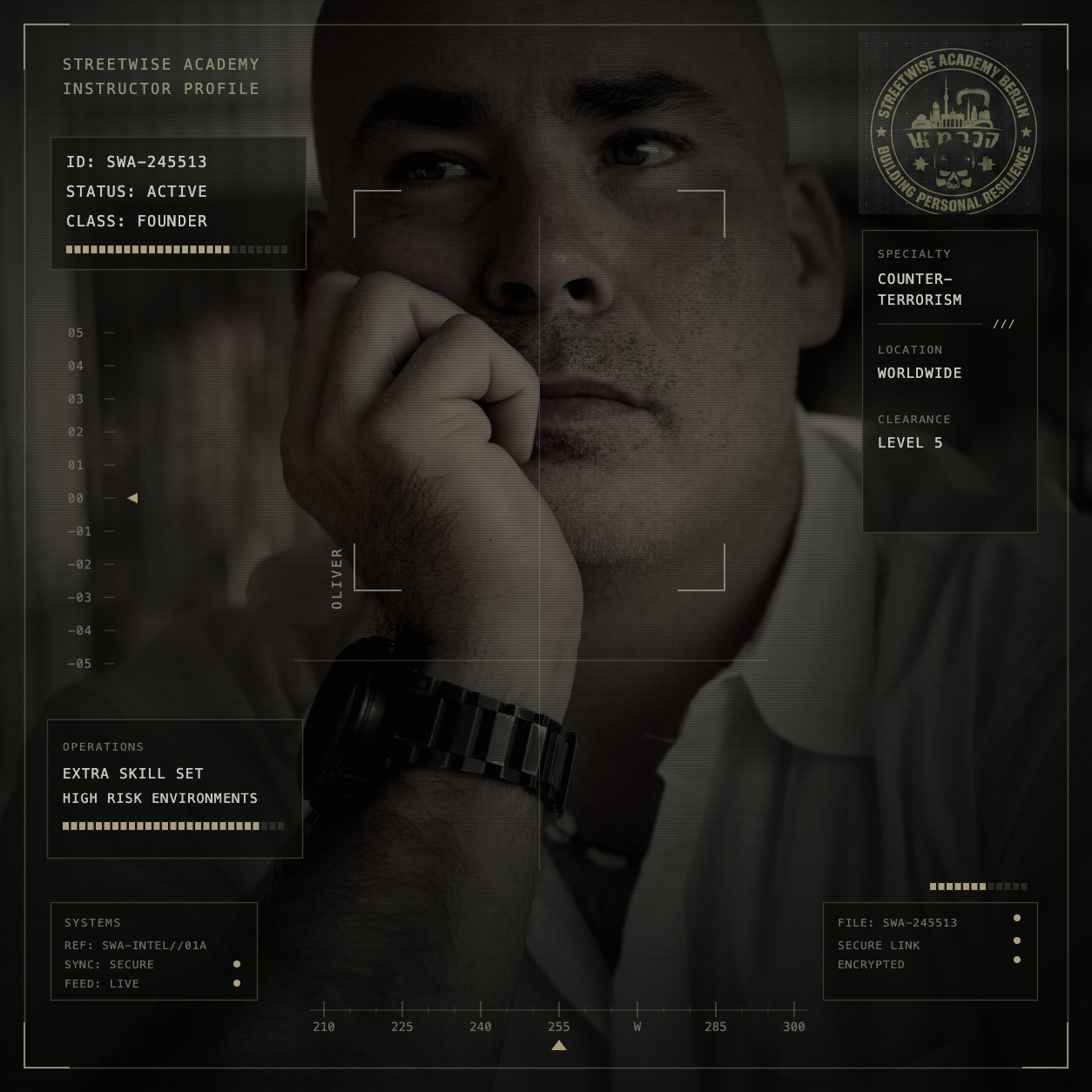
Die Ausbildung wird von Oliver geführt und je nach Baustein durch Instruktor*innen aus taktischer Medizin, Einsatztraining und Szenarienarbeit ergänzt.
Rahmen & Anfrage
So kommt ein Programm zustande
Am Anfang steht ein Gespräch: Wer seid Ihr, was gibt es schon, was ist der Auftrag. Daraus entsteht ein Vorschlag mit Umfang, Terminen und Konditionen — und erst dann wird geplant.
Für Gemeinden und gemeinnützige Träger finden wir in der Regel eine Lösung, die nicht am Budget scheitert. Sprich uns an.
Kontakt
Erzählt uns von Eurer Lage
Ein kurzer Anruf oder eine Nachricht genügt für den Anfang. Vertraulich, ohne Verpflichtung.
What this is about
The first minutes are yours
Whether it is a congregation, a school, a clinic or a company — when something happens, time passes before police and paramedics arrive. Whoever is on site carries that time. A First Response Team is the answer: a fixed, named, practised group from your own ranks that knows what to do in those minutes — and what explicitly not to do.
We build such teams, train them and keep them current over the years. The basis is Israeli community-security methodology, translated into the legal framework of each country — carried by almost three decades of experience in Berlin.
This is not an off-the-shelf course. It begins with an assessment and does not end on the last day of training, but with a plan for keeping the team in practice.
The teams come from within the organisation itself — volunteers, as a rule four to sixteen people, and deliberately from every part of the house. In a Jewish school such a team may bring together the caretaker, two teachers, the co-director, a cook and the system administrator. That spread is intentional: it puts different routes through the building, different keys, different perspectives and different skills around one table.
Relevant background is welcome — medical training, OSINT experience, martial arts, technical skills. It is not what decides. The two qualities that really matter are brains and commitment: someone who thinks along and stays the course is worth more to a team than any prior qualification. Everything else we teach.
The scope
80 hours of basic training
The basic training comprises 80 net hours in ten modules of four to 24 teaching units. Two of those modules run as block seminars with two overnight stays each — full board, transport and all training, protective and exercise material are included.
Training takes place in groups of up to twelve, in day and block seminars that fit your site and your people. It closes with extensive scenario training under realistic conditions.
It does not stop there. Depending on the threat level of the organisation, we run refresher training weekly to quarterly — without that repetition every team falls apart within months. Members work on a voluntary basis; the organisation provides the training.
The training
Four areas, ten modules
The ten modules are spread across four areas. They build on each other: detect, act, treat, hand over. How deep each area goes depends on the mandate and on the threat level.
01 ·Prevention
Predictive profiling, counter surveillance, violence dynamics, technical security, quality assurance of your own procedures, PTSD prevention and advising your own team. The part that prevents most incidents before they become one.
02 ·Immediate threat response
Unarmed close combat based on Krav Maga and the handling of weapons: firearms, knives, impact weapons, chemical agents and improvised means. Live fire takes place on approved ranges under the supervision of a range safety officer and a shooting instructor — within what the mandate and the law of each country allow.
03 ·Tactical medicine
TCCC and TECC principles, trauma response training and the use of tactical medical equipment. Massive bleeding, airway, warmth — the area that is genuinely needed most often.
04 ·After incident procedures
Briefing and handover to police, fire brigade, emergency services and civil protection, work at the scene, securing witnesses and evidence, monitoring the quality of the response. What happens after the first minutes decides investigation and prosecution.
The building blocks
Eight building blocks, one team that holds
Which blocks are in your programme, and how deep they go, depends on the mandate. They are spread across the four training areas and reach from setting up the team to the annual exercise.
01 ·Mandate and legal framework
What the team may do, what it should do and where the line runs — written down before anyone trains. Every country and every organisation has a different framework.
02 ·Selection and set-up
Who belongs on the team and who does not. Resilience, availability, role in everyday life. Six reliable people beat twenty names on a list.
03 ·Situational picture and alerting
Who notices what first, how the report gets through, who decides. Alerting routes that also work at night and during holidays.
04 ·Recognising attack preparation
Casing, dry runs, unusual interest: the indicators before the act. Observe, document, pass on — without paranoia in everyday life.
05 ·Access and perimeter
Entrances, events, visitor flows. How to guide people through a check politely and still effectively.
06 ·Physical intervention
Capability at the level the legal framework allows: keep distance, break free, hold on, buy time — not fight to win. Where mandate and law allow it, the handling of weapons is added, up to live fire on approved ranges.
07 ·First care under conditions
Tactical medicine to TCCC and TECC: massive bleeding, airway, warmth. The part that is needed most often in practice.
08 ·Practising and sustaining
A yearly plan of short repetitions, one scenario day per year, clear debriefs. Without that, every team falls apart within months.
Who this is for
Three starting points, the same task
The programme is aimed at groups who are there first in an emergency — not at individuals. Participation only as a closed group.
Jewish and Israeli institutions
Community centres, schools, synagogues and events, as well as Israeli cultural and educational institutions, businesses and projects. The field the methodology comes from and where we have been working since the 1990s.
Kitot Konenut and standby groups
Existing units that are to be trained in a structured way, sharpened up and brought into a fixed exercise year.
Human-rights NGOs and targeted premises
Organisations working on antisemitism, racism, women's rights or extremism — and buildings targeted by Nazis, Islamists, racists, antisemites or misogynists.
We build First Response Teams exclusively for human-rights NGOs, for Jewish and Israeli institutions and for premises targeted by Nazis, Islamists, racists, antisemites or misogynists. We do not work for other organisations — that is not a question of capacity but a decision.
The benefit
What both sides get out of it
A First Response Team has to add up twice: for the institution that sets it up, and for the people who carry it voluntarily. Both sides stand side by side here.
For the organisation
9 reasonsWhat an institution gains by relying on its own people instead of booked services.
Costs in proportion
Setting up an FRT costs a fraction of permanently booked security services. For many institutions it is the only way to be protected at all, rather than on selected days only.
Almost always someone on site
The team consists of people who are there anyway — at the small meeting, on the outing, at the evening event. Exactly where nobody would order a guard service.
Commitment instead of a duty roster
Your own people look after your own people. Someone standing at the door for 12.70 euros an hour will get themselves to safety first if in doubt — professionals do that too. Nobody in your own team does that maths.
Knowledge that stays in the house
The expertise belongs to the organisation, not to a contractor. It does not leave with the next change of contract and is available internally for every event, every rebuild and every trip.
The view from inside
The team knows the building, the routes, the keys and the routines — and the people. Someone who does not belong here stands out to your own people weeks earlier than to a rotating post at the entrance.
Protection without the look of a fortress
No uniforms, no lockdown. The character of the congregation, the school, the house stays intact — the capability is there all the same, invisible to everyone else.
Compatible with the emergency services
Named contacts, a practised handover, prepared situation information. Police, fire brigade and paramedics work faster when they find someone on arrival who can report in a structured way.
Robust towards the outside as well
Roles, alerting routes and exercises are documented and can therefore be evidenced to boards, funders and insurers. And inside the house, fear goes down: events take place instead of being cancelled.
Detecting instead of reacting
Preparatory acts — casing, dry runs, unusual interest — show over weeks. Whoever is in the building every day recognises that pattern. A rotating guard force only ever sees today.
For the members
9 reasonsWhat the people take away who take this on alongside their actual work.
Training you cannot get elsewhere
80 hours with instructors from the military, the police, emergency medicine and combat sports. In this combination — prevention, close combat, shooting, tactical medicine, forensics, risk & threat assessment — it is practically unavailable in civilian life.
Leadership under pressure
Deciding on incomplete information, speaking clearly when others fall silent, assigning tasks without debate, debriefing honestly afterwards. Leadership is learned nowhere faster than in situations without a second round — and in working life it is the scarcest skill of all.
Knowledge for life
Stopping a massive bleed, fending off an attack, reading a situation, reading a room. That helps in traffic, while travelling, in your own family — and in any other job.
A scholarship for a Krav Maga school
Members train as often as they like. Fitness, stress resistance and resilience are part of the training, not a side note.
Capable instead of exposed
The difference between “I hope nothing happens” and “I know what I will do then” is the biggest gain in calm this task brings — in everyday life as well.
Team, network and more
Many of our activities are unique. Anyone who proves to be a reliable team member is offered more — and a network that reaches beyond their own organisation.
What arrives at home
What you learn does not stop at the door of the institution. Home, travel, children, your own parents — the first group to benefit from the training is usually your own family.
A qualification that stays
Training status and refreshers are documented. Anyone who eventually leaves the organisation takes a verifiable qualification with them — in the events, security and rescue sectors it counts immediately.
Dealing with what comes afterwards
The training covers the aftermath of an incident: what is normal, what to watch for in yourself and in others, and when to get help. That knowledge carries far beyond the role.
The location
At your site — or on our ground
The largest part belongs at the real place: your entrances, your routes, your event rooms. What is practised there sits later where it is needed.
Individual blocks — physical capability, tactical medicine, scenario runs — work more efficiently in our hall in Berlin or on a training ground. Both can be combined, and training abroad is possible as well.
What we bring
Material, method, experience
Training material, protective equipment for the contact parts, medical practice material and scenario props are provided by us. You provide the rooms and the people.
Plus the documents that make a team viable in the first place: role descriptions, an alerting scheme, a twelve-month exercise plan and a debrief sheet for every exercise.
Leadership
Who runs the programme
The training is led by Oliver and, depending on the block, supported by instructors from tactical medicine, operational training and scenario work.
Framework & enquiry
How a programme comes about
It starts with a conversation: who you are, what already exists, what the mandate is. From that comes a proposal with scope, dates and terms — and only then do we plan.
For congregations and non-profit organisations we usually find a solution that does not fail on the budget. Talk to us.
Contact
Tell us about your situation
A short call or a message is enough to start. Confidential and without obligation.